Wednesday, September 30, 2009

Is That a Bird on Your Head? No, It's An Audobonnet!


Plume hunters decimated bird populations not only in the United States but overseas as well. This satin hat, from about 1910, sports a greater bird of paradise from Papua New Guinea.
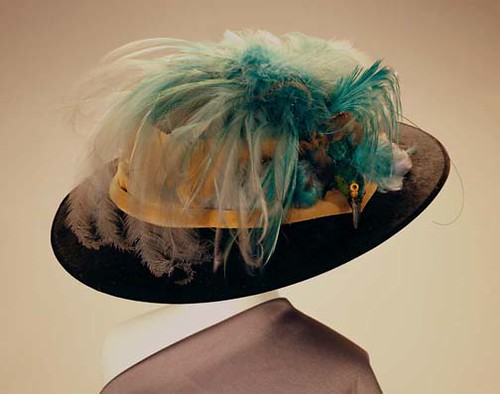


Hat with Bird of Paradise, ca. 1900 by Missouri History Museum.Large Black Plush Hat with Bird of Paradise, ca. 1900. Photograph by Cary Horton, 2004. Missouri History Museum, Museum Collections. Acc.# 1953 077 0001. N28866. Photograph © 2004, Missouri History Museum.

Published in the Syracuse, NY daily journal, 1898.


The Pennsylvania Audubon society for the Protection of Birds has just held,
in Philadelphia, an exhibition of bonnets which were trimmed without
the use of birds' plumage. The Philadelphia Record,which says that 
the bonnets were very beautiful, calls them Audubonnets.


Women's hats of the late 1800s and early 1900's were decorated with not just feathers of birds, but often the entire bird was used and mounted on wires to make it move in a 'natural way'. It was an important fashion and social status symbol, not taking into account the destruction of wildlife.


Naturally, (and thankfully) Theodore Roosevelt was a great proponent of wildlife conservation. Along with the Audubon Society, he realized they needed to set limits in order to protect rapidly disappearing wildlife. They pushed for hunting regulations and established conservation groups to protect habitat. He was the backbone of the National Wildlife Conservation Model in the USA.

And good thing too. This resulted in the realization that wildlife was not needed for fashion. Many of us can get a little squeamish while looking at the above photos. Those are real, dead, stuffed birds. Not something we would value today. As well as knowing this is unethical, we have chosen alternatives to using living things for vanity. Feathers are still used today in millinery practice, but the animals are not killed for their plumes.

I would rather wear these 'Audubonnets', thank you.


Monday, September 28, 2009

The Lure of Taffeta

Taffeta. A very popular fabric for dress making. I had a friend who loved taffeta so much she even made her shower curtain from this beautiful fabric!

There are many different types of tafetta. Most are made of a fine, plain weave, usually smooth, crisp and lustrous. Faille (pronouced sort of like 'file') has a softer feel to it with a ribbed weave. When you see an iridescent effect to your dress, the fabric is called a changeable taffeta - warp and weft are different colors.

Taffeta is originally a Persian fabric known as Taftan. Mostly reserved for dresses and gowns, their cleaning can prove tricky. Never wash tafetta in water, always use a dry cleaner. It is known for color runs, and can be very difficult to press if wrinkled in water.

However, the look of taffeta can not be denied!


Saturday, September 26, 2009

New Website Re-Launched!


We have re-launched our website!


Help celebrate with us!

FREE SHIPPING to Canada & USA until October 31st.

www.somelikeitvintage.com

Wednesday, September 23, 2009

Saddle Me Up!

Saddle shoes. If James Dean wore them, they must be cool.

I have always loved saddle shoes. Those white & black leather loafers that have been around since the 1920s - well before sneakers were fashionable.

Originally black and white, Spalding, the sporting goods company, claims it made the original saddle oxford as a gym shoe for tennis, field hockey, fencing and badminton. They were made with an 'overlaying saddle to give additional strength at the point of stress' (aka, the instep).

In World War II, brown & white saddles became popular when the black dye for the leather was hard to find.

In the 1950s, saddle shoes surged in popularity. They were commonly worn by both girls & boys from that time through the 1960s, the girls often being referred to as 'bobby-soxers'.


Today, saddle shoes can be found in a rainbow of colors, and we have just brought in a gentleman's pair from G.H. Bass & Co.


Granted, sneakers are practical for most sports today, but for walking around I would rather wear a pair of classic saddles than these PINK DICE ones! Yeesh.

Friday, September 18, 2009

Collector's Weekly


I don't just adore vintage fashion, but pretty much anything vintage will catch my eye. Including antiques. To follow up on my last blog entry, Collector's Weekly is a San Francisco based online antiques and collecting publication dedicated to showcasing the passion and knowledge of collectors.

With a collecting basics section, you can find information, interviews and articles on just about everything that is collectible today. (Which is a lot!)

Do you collect guitars? Silver? Comics? Tractors? Yes, full sized farm equipment...

And then of course there is the fashion section.

Have a look, it's a wonderful place!

Sunday, September 13, 2009

Swimwear Interview

Melissa over at Collector's Weekly sent me a copy of a wonderful interview they have recently done with vintage swimwear collector, Pam Fierro.

I have posted an excerpt here, and if you wish to read the entire article please visit the Featured Interview page.

Who are some of your favorite designers?
Fierro: I love Claire McCardell, and I really like Rudi Gernreich and Elsa Schiaparelli, although I don’t have anything by Schiaparelli yet. I like Christian Dior, and I would love to find a piece by Jean Patou or Chanel. Rose Marie Reid has done some fabulous pieces, as have Esther Williams, DeWeese, Catalina, and Jantzen. I have a lot of pieces by Jantzen because they have such a long history in swimwear. They were one of the first big collections that I put together.


What materials were used to make bathing suits?
Fierro: The earlier suits were often made out of jersey. Wool was popular, as was silk. Then rayon was promoted as artificial silk. Nylon came about in 1938, which was revolutionary for the swimwear market. Another innovation was Lastex, which came out in the late ’50s. In the 1960s, a lot of different fibers started coming out like Bri-nylon, rayon jersey, and Lycra. Those were very influential on the swimwear market as far as being able to dry quickly or being more form fitting and less see-through.

Were bathing suits mass-produced or made by hand?
Fierro: They were mass-produced by machines. The first wool suits were woven on machines, and then Jantzen developed the rib knit suit, for which the woolen knit was mass-produced and then made into swimsuits.


Wednesday, September 9, 2009

Taxi Dancers

Hankering to do the jitterbug but don't have a partner? Does your significant other have two left feet?

Why not hire yourself a 'taxi dancer'. A long-lost profession that is now enjoying a revival, it turns out many people will pay to be twirled properly on the dance floor.

The term 'taxi dancer' originates from the 1920s and is derived from the fact that a dancer's pay is proportional to the amount of time spent with a patron, like that of a taxi driver. For example, in Berlin between the two world wars, ousted aristocrats and jobless army officers with posh manners began earning money spinning ladies in the city's many dance halls. Apparently, Hollywood director Billy Wilder, allegedly worked as a taxi dancer in Berlin for several months in 1926 whe he was 20 years old.

Everyone enjoys seeing professional dancers. Although the hit show 'So You Think You Can Dance?' mostly demonstrates modern street-style dancing, there are many folks who prefer parquet floors to hammering techno beats.  In some European cities, there is a need for professional dancers for hire. Genteel, fetching and dazzling on their feet, these men and women offer their services on the dance floor for anywhere between an hour and an evening, depending on how much you are willing to pay.

My toes are already tappin...we need some dance wear!


Friday, September 4, 2009

Fido, Bring Me My Slippers...

How do you shuffle around the house? And what do you call those things you put on your feet that are not quite a shoe, but are only worn indoors?

I call mine slippers. But I have also heard these terms: slippies, booties, fuzzies, house shoes, baboosh, pantofle, slipshoe.

What do you call yours? Are they warm and fuzzy or satin and sexy? Do you look to them for comfort or a simple change when you get home. Tell me about your slippers.

Vintage slippers now available.


Thursday, September 3, 2009

I Say Pinafore, You Say Apron....

...which is it?

A popular item of clothing up until the 1970s, an apron or pinafore was used to protect a ladie's clothing from housework dirt. It resembled a dress, often sleeveless and was worn over clothing. Later on it was adopted as a fashion piece. Also known as a pinny, every once in awhile I like to don a traditional apron while preparing dinner - something very comforting about not splattering my day clothes.

 
Do you wear an apron while preparing meals? I'm also talking to you gents.... you never know.