Friday, May 29, 2009

Need Help With That?


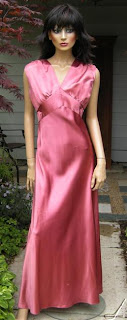
Well ladies, if you ever own a vintage dress like this 1950s Perlmutt Model, I hope you have a significant other, friend, neighbour to help you with it.

This stunning dress may have been designed by an engineer and constructed by an architect. Using a series of eyes & hooks, the tafetta crosses over the chiffon and the chiffon crosses over the tafetta. Confused yet?
Have a look and see what I mean.


and VoilĂ !!

I'm selling this one with instructions. Perhaps an instructional video.
But well worth it!

Tuesday, May 26, 2009

Vintage Gloves Part II


The length of a glove is traditionally expressed in buttons, an antique French unit of measure which is slightly longer than one inch. Button measures are customarily taken from the bottom of the thumb seam to the top of the glove.


The various traditional lengths are:

2-button Also known as shorties. These are wrist-length gloves, generally 8 to 9 inches long.

4-button These gloves are 10 to 11 inches long and cover the wrist, reaching a couple of inches up onto the forearm.

6-button 12 to 13 inches long, these gloves reach well up onto the forearm. Many gauntlet type gloves (i.e., these gloves with flared armpieces in the style of equestrian gauntlets) are this length.

8-button 14 to 15 inches long, this type of glove reaches to the upper forearm. This is also known as the "three-quarter" length glove

12-button Approximately 18 to 19 inches long, this type of glove reaches up to and just over the wearer's elbow. Known as elbow-length, many have wrist openings (called mousquetaire).

16-button 22 to 23 inches long - this is the classic Opera length, and as a general rule comes with the wrist opening.

21-button 27 to 29 inches long, the very longest of the glove length. This glove generally reaches all the way to the wearer's armpits. This is generally worn only with strapless or sleeveless evening outfits.

Sunday, May 24, 2009

New Items!

We've been busy! Here is a small sampling of some new items that are now available.


Thursday, May 21, 2009

Throw Down Your Gauntlets!

Vintage glove sizes are about a size smaller than modern glove sizes, and vintage size 6, which is one of the most common vintage sizes, is too small for many modern hands. If you want to wear vintage gloves, you should look for at least a size 7, preferably a size 8, depending on the size of your hands.

The pricing of a vintage glove will depend to a large extent on its condition. Brand-new kidskin opera gloves will sell from anywhere from $150 to $265 but you can get good-condition vintage kidskin opera gloves for much less from a reputable vintage seller. Good condition leather gloves should still be soft and smooth with minimal staining.


Kidskin Leather Opera Length Gloves, c. 1950s

Stay tuned for my next post: Different lengths of gloves.

Saturday, May 16, 2009

Harlem Fashion


Harlem, New York fashion was a style popular in the 20s. It was a time when ladies dressed for lunch, white gloves were the norm, gentlemen wore ascots and never left home without a walking stick and top hat.

Harlem was a mecca for excitement and glamour. Flappers, chorus girls, jazz talent, club singers, and beautiful fashion were found everywhere. The rise of stars such as Lena Horne, Billie Holliday, Dorothy Danedridge, Cab Calloway, Duke Ellington, Sarah Vaughn and others led the way for the Harlem community to look up to these stars and emulate their fashion taste. Like today’s superstars, they influenced their fans to follow their fashion lead.

This was a time of prominence, elegance, good social upbringing and pride. Harlem debutantes were elegant and graceful. Their gowns were the height of fashion. Ophelia Devore taught young ladies the art of gracefulness to go with those beautiful dresses, and it was the birth of the Zoot Suit.


It Figures

Want to wear vintage but don’t know where to start?

You need to know what era suits you. Curvy figures work well with the fitted silhouettes of the 1940s and 1950s.

If you have a a straighter figure, then the boxy shapes of the 1920s and 1960s will be more your style.


You may like the glamorous bias-cut styles of the 30s, as seen in the films Atonement and Gosford Park, but be aware that those figure-skimming dresses are unforgiving on a round tummy or large bust.


Keep your own figure in mind to avoid ending up with a wardrobe full of beautiful clothes you’ll never wear.

Be realistic. Don’t go into a vintage dress shop hoping to be turned into Audrey Hepburn. Only Audrey can be Audrey.

Ignore the label sizes. Try on the garment. Know your measurements or carry a tape measure if you are not able to use a fitting room.

Thursday, May 14, 2009

Tomorrow Children's Fund

If you will be in the area of the Fort Lee Community Center in New Jersey on Friday, May 15, 2009 at 7:00 p.m, join hosts Jessica Weinstein, Bianca Duran and Deanna DeFilippis for a benefit fashion show. All proceeds will be donated to The Tomorrow Children's Fund, a charitable foundation located at the Hackensack University Medical Centre. Clothing to be donated by yours truly, Some Like it Vintage.

To learn more about the Tomorrow's Children Fund: http://www.atcfkid.com/ or visit their MySpace page for further details on the show.

Tuesday, May 12, 2009

You Look Like a Million Bucks!

The 1930s were about hand-me-downs and making do. However, they were also about avant garde designers - Elsa Schiaparelli and Madeleine Vionnet of the bias-cut glamour gown.

Traditionally, fashion and status and wealth were completely linked. These avant garde designers were making lovely things, but not very many people could afford it.

Coco Chanel, known for her trim suits, little black dresses and clever knits, blurred the classes. She could easily translate haute mode to everyone else. She took the esthetic of poverty and made it fashionable. Chanel transformed the jersey, which was basically used for fisherman's underwear, into a fashion fabric worn by the Parisiennes. And it was she who made costume jewellery chic, not scandalous, when she wore heaps of faux pieces mixed with genuine gems.

Anyone can look like a million bucks!
But note the irony here: a Chanel suit is upwards of $1000 today. You will have to find a different designer who blurs the classes.

Saturday, May 9, 2009

Recession Depression? No Way!

For the past few seasons, fashion has been taking its cues from the 1930s and the Depression era. Contrary to popular belief, when it came to style, the Depression era was anything but depressing. "In North America, Hollywood was one of the biggest influences in the '30s and there's quite a parallel in the boom in cinema going on now," says Alison Matthews David, instructor and historian in the fashion program at Toronto's Ryerson University. The old Hollywood glamour is back.

Fabrics like nylon and rayon -- the "artificial silk" that cost half the price of the real stuff -- allowed relatively poor women to add richness to their dress, especially in terms of colour. It was an era of florals and luscious colours, much like today's styles at every price level, from Old Navy to Prada.

Add a little glamour to your wardrobe. We may be in a recession, but it does not have to be depressing!

My 1930s ebay picks.


Wednesday, May 6, 2009

Tuesday, May 5, 2009

Why I Love My Job!


This is why I love my job!

My latest acquistition of a wool worsted tuxedo coat tails, c. 1962. The inside pocket tailors label reads it was made for a Mr. WJR Wilson, Esq. Tailored by Jones Chalk & Dawson Ltd., 6 Sackville Street, Piccadilly, London, England. Silk lined and stunning!

When I opened the front breast pocket the original tailors work ticket was still folded inside! What fabulous history! In the biz, we call this 'provenance'.


Monday, May 4, 2009

That's a Funny Name


Cummerbund. Go ahead...say it 5 times. Isn't it funny? :-)

What is a cummerbund for?

Generally worn with a dinner suit, a cummerbund is a band of pleated material, often silk worn around the waist. It is worn for appearance only and was first used by high ranking British army officers.

A modern use of the cummerbund could be to tuck in a beer belly or an unsightly bulge. Since it is worn at the waist above the hipbone, it creates an illusion of a higher waist and longer legs. But be careful! It can also enhance a larger waist. Despite David Beckham temporarily invoking interest in them by wearing one without the matching tie, the cummerbund is still considered old-fashioned.

However, the traditional cummerbund can look less like a cummerbund and more like an accessory:

Gucci and John Galliano have added cummerbunds to their clothing lines. In order to update the look, take the cummerbund out of the context of formal wear and into a causal chic look. When David Beckham wore the look, he chose to forego the tie and unbutton the shirt. It was a winning look.

If you decide to add a cummerbund to your outfit, pleats facing up please!

Friday, May 1, 2009

'Heights' of Fashion


Platform shoes have appeared for centuries in cultures around the world. In ancient Greece, actors wore thick-soled shoes to heighten their stature before their audience. In Europe, from about 1600-1750, some women in high society wore tall pedestal shoes called copines. Thick platform shoes were fashionable in the Manchu culture of Northeast China. Japan’s platform sandals became part of the traditional dress of geishas.

In the 1930s, Salvatore Ferragamo is the man credited with transforming platform shoes from beachwear to high fashion with the first wedge heel. The popularity of platforms reached its greatest height in the 1970s, when these shoes became associated with a rebellious youth movement. From the free-spirited fashions of the 1970s to the trendy footwear of today, platforms have continued their role as fashion statements worn by both sexes.

Currently running at the Mint Museum of Art in Charlotte, USA, The Heights of Fashion: Platform Shoes Then and Now showcases more than 60 platform shoes from the 1930s through the present. Ranging from the delicate “lotus bud shoes” of 19th century China designed to emphasize women’s tiny bound feet to the chunky Goth platforms of the 1980s, the shoes on exhibit demonstrate how extreme variations on a style developed in response to different cultural philosophies and concepts of beauty.


The Heights of Fashion will be on display at the Mint Museum of Art through spring 2011. For more information, visit http://www.mintmuseum.org/.